Try us out for free
- 1 Pro-Level Edit ($300 value)
- 3 Custom Thumbnails ($150 value)
- Channel Growth Audit ($100 value)
Total Cost:
$550
$0
Takes 2 minutes. No credit card required.

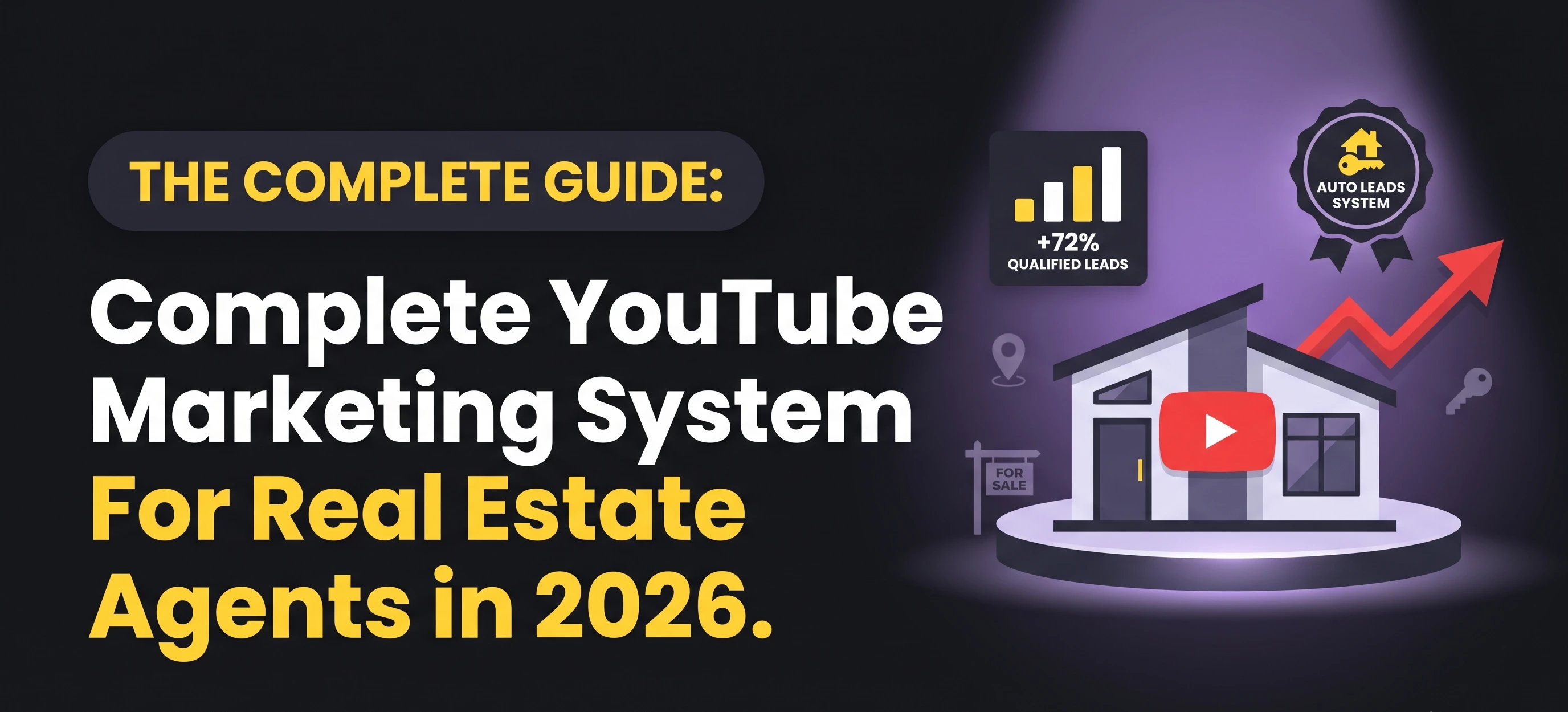
TL;DR: The Complete YouTube Guide for Real Estate Agents in 2026 works when it's treated as a search system, not a content habit. That means four content pillars, videos built for watch time instead of quick views, titles and thumbnails built for search intent, and a publishing cadence you stick to for months, not weeks. Get the system right and one video can outperform a hundred random ones — sometimes with a fraction of the views.
Most YouTube marketing for real estate agents fails for the same reason: agents post like they're on Instagram, then wonder why a video they spent three hours filming sits at 40 views. YouTube doesn't work like a social feed. It works like a search engine, and it rewards agents who feed it exactly what buyers and sellers are already typing into Google.
The agents pulling steady leads from YouTube aren't the ones with the biggest following or the flashiest drone shots. They're running a system — the right content categories, the right video length, the right titles, published on a schedule they don't abandon after month two. This post walks through that full system, piece by piece.
The pattern shows up over and over: an agent posts a burst of videos, gets discouraged by low views, and quits right before the channel would've started working. Jamil Academy's YouTube SEO breakdown notes that ranking momentum typically kicks in around months four to six — which means most agents quit at exactly the wrong moment.
The deeper problem is usually the content itself. Reposting a 90-second Instagram Reel to YouTube and calling it a strategy doesn't work, because YouTube's algorithm isn't built to reward short, low-retention clips the way Instagram's is. It's built to reward videos that answer a specific search, in enough depth that people stick around.
There's also a targeting problem. "Real Estate Tips" as a title tells the algorithm nothing about who should see it. A title like "Moving to Reston VA in 2026 — 7 Things You Should Know" tells YouTube exactly which searches to surface it for. Geography is your advantage here — most agents never use it.
A complete YouTube marketing system for real estate agents combines four things working together: a content strategy built on searchable topics, video editing built for watch time, SEO on every title and description, and a publishing schedule you run for a year, not a month. Miss any one piece and the other three underperform.
Most agents only ever build one piece. They film consistently but skip SEO. Or they nail the titles but the editing is rough enough that viewers bounce in the first 30 seconds — which YouTube reads as a negative signal and quietly stops recommending the video. The system only compounds when every piece is in place at once.
This is also where the "record it yourself, outsource the rest" split becomes worth considering. You know your market. You don't need to also become a video editor, a thumbnail designer, and an SEO specialist to make this work — you need those three things handled by someone who does it daily. That's the gap Syntak Media was built to close.
Every real estate channel that generates consistent leads is built on four content pillars: market updates, neighborhood guides, buyer and seller education, and local authority content. Skipping any one of these leaves search traffic on the table that a competitor agent in your market will happily pick up instead.
Pick your geography and lean into it hard. As Coach Emily Terrell's guide puts it, both a broad "moving to [city]" video and a narrower "best neighborhoods for young professionals" video earn their place on the calendar — one for volume, one for intent.
YouTube videos for real estate agents should run 7 to 12 minutes for most content types — long enough to satisfy watch time, short enough that you're not padding for the sake of it. RealtyHack's long-form playbook puts the sweet spot at 8 to 12 minutes as a general target, with the actual right length being whatever fully covers the topic without dragging.
This is the opposite of what works on Instagram or TikTok. Where those platforms reward brevity and completion rate, YouTube's algorithm still rewards total watch time — minutes watched, not percentage finished. A 90-second listing clip that performs on Instagram will get buried on YouTube, and a 10-minute neighborhood breakdown that thrives on YouTube would feel bloated as a Reel.
The 2026 algorithm update has also shifted weight toward "viewer value" signals — shares, saves, comments, and consecutive minutes watched — over pure click-through rate. Cut the branded intro. Cut the slow warm-up. Open with the answer to the question your title promised, in the first ten seconds.
Your title needs your geographic keyword, your topic keyword, and a specific reason to click — all in one line that still reads naturally. "Living in Southlake Texas: What You Need to Know Before Moving" beats a vague, brand-first title every time, because it matches exactly what someone is searching for.
Thumbnails matter more than most agents assume. Jamil Academy's data puts custom thumbnails at 8 to 15 times the click-through rate of an auto-generated frame — meaning the thumbnail alone can be responsible for half of whether a video gets watched at all.
Your description matters too, and most agents leave it nearly empty. YouTube reads your description to understand what the video covers, and Google indexes that same text for search results outside of YouTube entirely. A few sentences that repeat your primary keyword naturally, plus a link back to your site, do real work here.
Upload consistency is itself a ranking signal — YouTube uses your posting pattern to predict whether viewers can count on you, and it rewards channels that show up on schedule over channels that post in bursts. A realistic ramp looks like this:
Six videos in three weeks followed by two months of silence does more damage than posting nothing at all — it trains the algorithm to expect inconsistency from your channel specifically. Bi-weekly, sustained for a year, beats sporadic every time.
One of Syntak's clients — a real estate agent named David — landed a $1.6 million listing from a video that had only around 600 views. The number that mattered wasn't the view count. It was that the right person, searching with the right intent, found that exact video at the right moment.
This is the mindset shift most agents need. A neighborhood guide with 600 highly targeted views from people actively relocating to your area will outperform a viral video with 60,000 views from people who will never buy in your market. Optimize for who's watching, not how many.
It's also why YouTube compounds in a way paid ads don't. A well-built video keeps surfacing in search and generating inbound interest for months after you publish it — long after an ad budget would've run dry. You can see more of how this plays out for other clients on Syntak's work page.
A real YouTube marketing system for real estate agents isn't complicated, but it does require every piece — the right content pillars, the right video length, real SEO on your titles and thumbnails, and a publishing schedule you don't quit on. Views are a vanity number; the right viewer, at the right search, is the actual metric.
You don't need to become a video editor or an SEO specialist to run this system. You need to keep recording, and hand the rest to a team that does it daily. See the Creator plan if you're ready to put full channel management behind your listings, or book a call if you want to talk through what this would look like for your market first.
Finding the right team to handle your YouTube content can be the difference between a channel that compounds into steady leads and one that quietly stalls at a few hundred views. With the right editing, SEO, and strategy behind it, your content can do the heavy lifting your sales team usually has to do manually.
If you're weighing a solo freelancer against an overpriced agency retainer, there's a middle ground worth considering.
We're not a freelancer, and we're not a $3,000-a-month agency — we're a dedicated editing and YouTube management team, working at a flat monthly rate with no hidden fees and no long-term contracts. Let's talk.
Unlimited video requests, unlimited revisions, one flat monthly price. You record, we handle editing, thumbnails, and full channel management.
How long should real estate YouTube videos be?
+Most real estate YouTube content performs best between 7 and 12 minutes. That's long enough for YouTube's algorithm to register meaningful watch time, and short enough to hold viewer attention if the content stays tight. The right length is ultimately whatever fully answers the video's title without padding.
How often should real estate agents post on YouTube?
+Start with roughly one to three videos a month in your first quarter, then build toward weekly by month four to six. Consistency matters more than volume — a steady biweekly schedule sustained for a year outperforms a burst of uploads followed by silence.
Do real estate agents need YouTube SEO, or just good videos?
+Both. A well-produced video with no SEO — no keyword-matched title, no real description, no custom thumbnail — will still struggle to get found. SEO is what gets the video in front of the right search; editing quality is what keeps people watching once they click.
How long does it take to see leads from YouTube as a real estate agent?
+Most agents start seeing real momentum around months four to six of consistent posting, which is also right when many agents give up. Videos published early keep generating views and inquiries well past that point, since YouTube content compounds over time instead of expiring like an ad.
Should real estate agents edit their own YouTube videos?
+You can, but it competes directly with the time you'd spend on listings and clients. Many agents record the raw footage themselves and hand off editing, thumbnails, and SEO to a team, which keeps the channel consistent without turning the agent into a part-time video editor.

Subham Kanoo
Founder, Syntak Media
I started Syntak because I kept seeing the same problem. Business owners knew video could bring in leads, but most just didn't have the time, editing skills, or energy to actually compete on YouTube. So I built Syntak to fix that. We take raw, unedited footage and turn it into a lead generation engine that works around the clock, so you're out closing deals instead of stuck editing clips. Today, Syntak is the go to editing partner for real estate agents and service professionals who want agency level video without the agency price tag.
Expertise
Unlimited editing, thumbnails, and YouTube management - one flat price, no hidden fees. Book a call to see your channel's growth plan.
Book a Call
Takes 2 minutes. No credit card required.